Rajasthan is not a place you can understand from an air-conditioned bus window. It’s too vast, too layered, too alive for that. The state is the largest in India, and it holds a staggering variety of worlds within itself, the painted merchant towns, golden desert cities, hilltop fort kingdoms, and peaceful villages where the rhythm of daily life has barely changed in centuries. There is too much here for any single journey to catch all of it. To really feel the essence of it, you need to be moving slowly enough to notice things, open enough to let it in, and free enough to stop when something catches your eye, right in the moment.
A motorcycle gives you all of that.
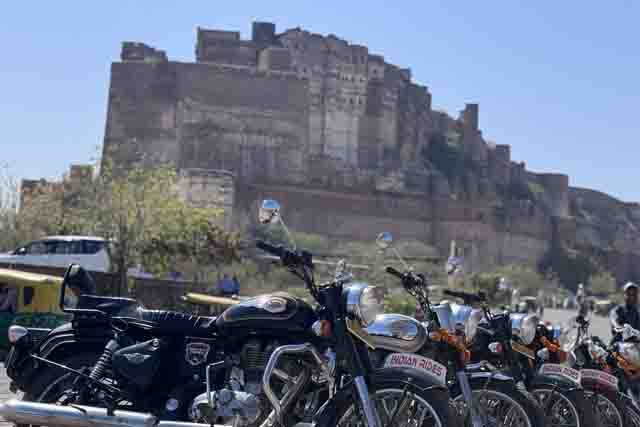
Not just any motorcycle. The Royal Enfield Bullet really is a symbol of Rajasthan, strong, slow, characterful, and built for these roads. Its quiet, regular beat echoes the pace of the trip. It suits experienced riders and is irresistible to those with a less-experienced sense of adventure. It has a calm demeanour and is equally confident on the desert stretches as well as on the Aravalli hills, on the village tracks or in the city chaos. After enjoying one through the sandstone terrain at dusk, with the entire sky turning pink, you know why they keep returning to this machine.
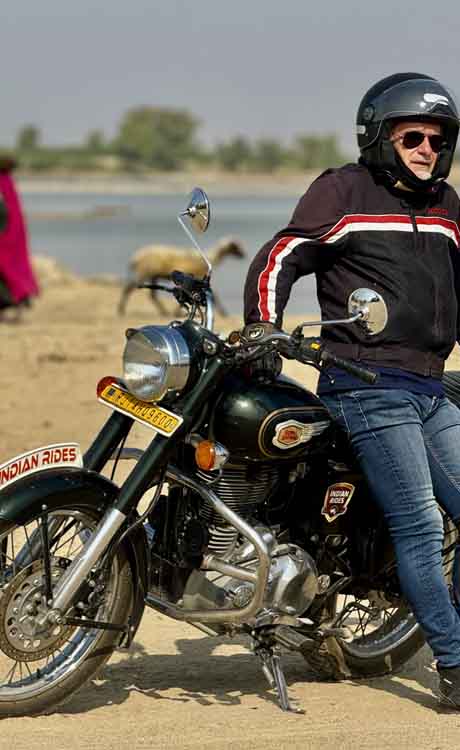
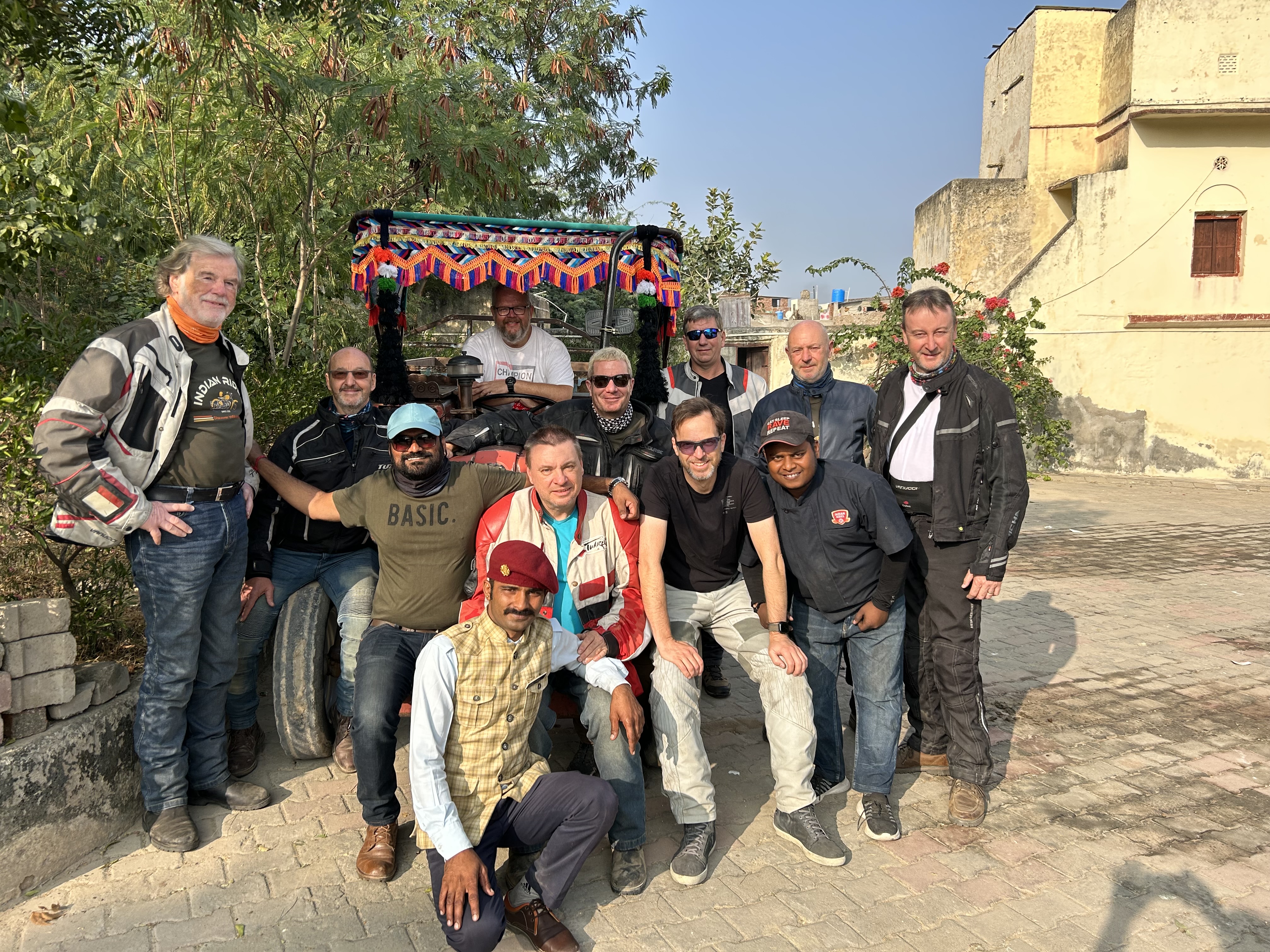
Indian Rides provides authentic Royal Enfield motorcycles for both solo and pillion, with luggage support and a dedicated mechanic. That mechanic, known to returning riders as Doctor Ram, rides with the group on every tour. He has not left anyone stranded yet. The group is small, usually limited to eight bikes, so that you have a true local experience instead of a “package” experience. This is more important than you would think.
Delhi
The tour opens in Delhi. Most international flights land here, so it is the practical starting point, and it earns its place on the itinerary. Old Delhi, with its centuries-old lanes and Chandni Chowk's chaotic brilliance, is a full immersion into raw India before you have even touched the road.
On the second day, you ride through it on your Royal Enfield, weaving past cycle rickshaws and street food vendors, stopping at the Red Fort and Humayun's Tomb, with Raj Ghat somewhere in between, working as a reminder of where modern India began before you ride to meet the ancient part of Delhi. By the time you reach India Gate at dusk, the bike already feels like yours.
By the end of Day 2, most riders have lost the initial nervousness and are now more open to thrill and to ride. The bike now feels familiar, and so does the group. The group has begun to bond over dinner. Narendra, the founder of Indian Rides, who guides most of the journey himself, has a habit of sketching out what your day will look like before the first meal. He does not oversell it. He does not need to.
Shekhawati
The first long day of riding takes you northwest out of Delhi toward Mandawa, a small town in the Shekhawati region. Most tourists never find it, which is their loss because Shekhawati contains something that deserves far more attention, hundreds of merchant mansions, or havelis, covered floor to ceiling in vibrant frescoes painted by local artists during the 18th and 19th centuries. The merchants who built these homes were wealthy traders who commissioned elaborate murals depicting everything from mythological stories to their own interpretation of the world, including early automobiles and steam trains that the artists had only heard about.
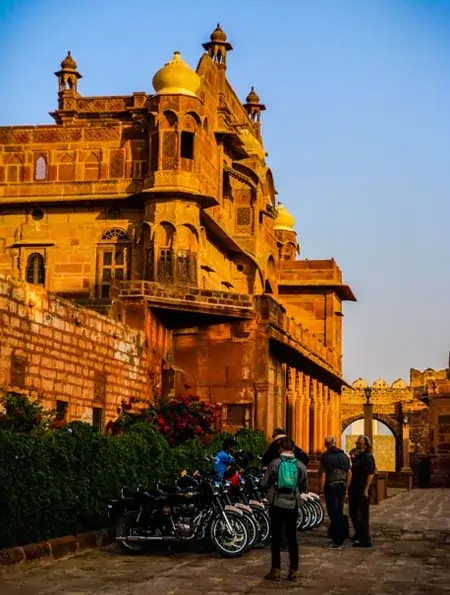
Staying at the Castle Mandawa, a heritage hotel built within an actual castle, feels like sleeping inside history. In the evening, you can take a camel ride through the lanes as the light drops, stopping to admire the crumbling walls. It’s one of those quietly magical stops that riders consistently name amongst their favourite moments on the tour.
The ride from Delhi to Mandawa is around 270 kilometres, mostly through open agricultural land that gradually gives way to the drier, sunbaked feel of Rajasthan. Good roads, manageable traffic, and your first real taste of the state's landscape.

Bikaner
From Mandawa, you head further into the desert toward Bikaner. Most of Rajasthan's great forts were built on hilltops, military logic demanded the high ground so that it was easy to monitor. Junagarh Fort in Bikaner breaks that rule spectacularly. Built on flat desert plains in the late 16th century, it compensates for its lack of elevation with sheer scale and architectural brilliance. The palaces inside, namely the Karan Mahal, Anup Mahal, and Badal Mahal, are extraordinary examples of Rajput and Mughal craftsmanship, with ceilings of gold leaf, intricate mirror work, and painted galleries that feel almost impossibly decorative for a military fortification.
Bikaner is also famous for the Karni Mata Temple, known as the Rat Temple, where thousands of rats are considered sacred and are protected. If you have even a slight bit of an interest in wildlife, the National Research Centre on Camels on the outskirts of the city is one of the few places in the world where camel breeds are systematically studied, and worth an hour if the landscape has started making you curious about how people and animals have survived it for centuries.
The 180-kilometre ride from Mandawa to Bikaner takes you through increasingly dramatic desert terrain, with open skies and very little space between you and the horizon. The road is so flat, and the silence so complete out here, that you stop planning things. The engine sets the rhythm, and your mind follows it.
Jaisalmer
If there is one city in India whose beauty stops you mid-sentence when you try to describe it, it is Jaisalmer. Built almost entirely from yellow Jaisalmer sandstone, the entire city glows at sunset in shades of gold and amber. At the centre of it all is Jaisalmer Fort, one of the largest fully inhabited fort cities in the world. People still live inside its walls, families, guesthouses, temples, shops, in much the same way they have for the past 900 years. Walking through its lanes at dusk, with the stone warm from the day's sun and the air carrying the smell of incense and cooking, is one of those evenings in India that you find yourself describing to people for years.
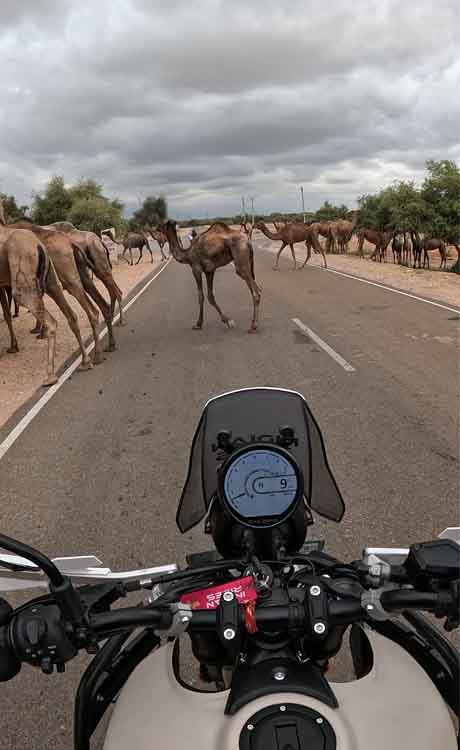
The ride from Bikaner to Jaisalmer is the longest of the tour at around 330 kilometres, crossing the deep desert of the Thar. This is where the Royal Enfield truly earns its reputation. Long, straight roads, desert on both sides, occasional trucks and camel carts sharing the route, and a heat shimmer on the horizon that makes the road look like it dissolves into the sky. It can be intense in the hottest months, which is why Indian Rides runs this tour between October and March, when the desert is dry but not this harsh.
Day 6 is spent going deeper into Jaisalmer. The Jain temples at Lodurva are worth the morning sunshine, older than the fort and peaceful. Most tourists miss it entirely, which means it is almost always quiet. Gadisar Lake and the Patwon Ki Haveli fill the rest of the day before an afternoon ride out to the Sam Sand Dunes. A camel ride at sunset across the dunes, followed by local cuisine dinner with Rajasthani folk music playing under the stars. It is the kind of evening you did not know you needed until you are sitting in it.

Jodhpur
The ride from Jaisalmer to Jodhpur passes through Osian, an ancient temple town with beautifully preserved Jain and Brahmanical temples dating back to the 8th century. It is a peaceful and undervisited stop that Indian Rides deliberately routes through the kind of place you would never find on your own.
Jodhpur itself is the Blue City, named for the vivid indigo-painted houses that cascade down the hillside below Mehrangarh Fort. The fort is one of the most impressive in all of Rajasthan, rising 125 metres above the city on a sheer rock face. Standing on its ramparts and looking out over the sea of blue rooftops below is a moment that stays with you. Inside, the palaces are magnificently preserved, with rooms that feel like the Maharajas only just stepped out.
The full day in Jodhpur also includes visits to Jaswant Thada, a white marble cenotaph so finely carved it looks like it belongs somewhere cooler and quieter, and the Umaid Bhawan Palace, which is still a royal residence and one of the world's largest private homes. The afternoon is spent in the Bishnoi villages, a community that has lived in close relationship with its natural environment for centuries, and one of the most moving stops on the entire tour.
Ranakpur and the Road to Udaipur
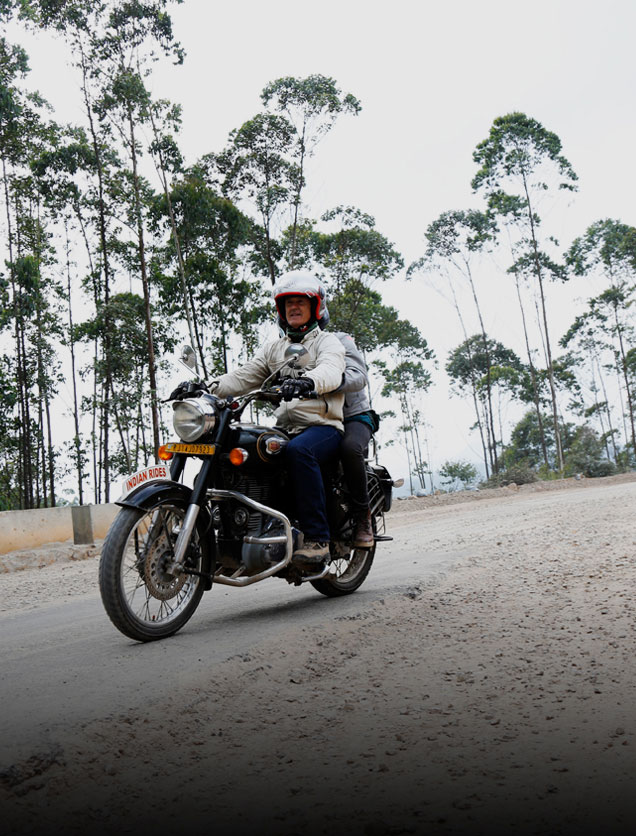
The road south from Jodhpur winds into the Aravalli Hills, and the change in landscape is striking. After days of desert, suddenly the terrain is green and rolling, the air is cooler, and the roads begin to curve and climb. This stretch of riding is among the most enjoyable lap of the whole tour.
Halfway to Udaipur, the route passes through Ranakpur, home to one of the most extraordinary Jain temple complexes in the world. Built in the 15th century, the main temple contains 1,444 intricately carved marble pillars, and no two are alike. The craftsmanship is so fine and so sustained that spending time inside feels more like standing in a sculpture garden than a place of worship. It is peaceful and calming.
Udaipur, when you arrive, feels like a reward. The City of Lakes is Rajasthan at its most romantic, with shimmering water, white marble palaces, and a pace of life that invites you to slow down. A full day here takes in the City Palace, one of the largest in India, with a museum holding an outstanding collection of royal armoury and miniature paintings. From there, Jagdish Temple and a boat ride on Lake Pichola to the island palace of Jag Mandir. The evening is best spent at Sajjangarh, the Monsoon Palace on a hilltop above the city, watching the sun drop behind the Aravallis.

Kumbhalgarh, Pushkar and the Road to Jaipur
The ride north from Udaipur toward Pushkar offers an optional stop at Kumbhalgarh Fort, and it is worth the detour. The fort is famous for its boundary wall, that is 36 kilometres long, making it the second longest continuous wall in the world after the Great Wall of China. It sits in the Aravalli Hills with far-reaching views over the surrounding landscape, and the drive up to it through scrubland and forested hillsides is one of the most scenic stretches of riding on the tour.
Pushkar is one of the oldest towns in India and one of the most sacred. Built around a lake, the town is calm and deeply spiritual in a way that is surprising even to visitors with no particular inclination to the religion. Its 52 ghats lead down to the holy water, and the one and only Brahma Temple at the town's heart. After the intensity of the desert cities, Pushkar feels slower and more peaceful.
The following day's ride to Jaipur passes through Ajmer, with an optional stop at Ajmer Sharif, one of the most important Sufi shrines in South Asia and a place of deep reverence for people of many faiths. The Qawwali music that fills the courtyard around sunset is one of the more unexpectedly moving musical experiences you will find anywhere in India.
Jaipur
Jaipur is Rajasthan's capital and its most famous city. Built in 1727, it was painted a distinctive terracotta pink and has kept the colour ever since. Local laws require buildings in the old city to maintain the shade. It is busy and full of things worth seeing.
The full day in Jaipur is centred on Amber Fort, a UNESCO World Heritage Site that sits on a hilltop overlooking a lake. The Sheesh Mahal (Hall of Mirrors) alone justifies the climb. Walking through the elaborately painted and carved Ganesh Pol gateway is as rich a heritage experience as anywhere in the country. Jaigarh and Nahargarh forts, both within reach of the city, offer sweeping views and a sense of the geography that defended and shaped Jaipur's history.
Back in the city, Hawa Mahal, the City Palace complex, and the 18th-century Jantar Mantar observatory, a UNESCO site, are all within easy reach. The markets of Jaipur are worth the time, too, in case you are willing to take home souvenirs, like the gemstones, block-printed textiles, blue pottery, and hand-embroidered goods of exceptional quality.

Fatehpur Sikri and the Taj Mahal
The final ride takes you from Jaipur to Agra along a route that passes through one of the most remarkable ghost towns on Earth. Fatehpur Sikri was built by the Mughal Emperor Akbar in the 1570s as his imperial capital, a planned city of red sandstone palaces, mosques, and courtyards that was then abandoned after barely 15 years, possibly due to water shortages. It has sat largely unchanged since, silent and perfectly preserved, like a city that simply stepped out of time. Walking through it with the knowledge of its brief, strange history gives it an atmosphere unlike anywhere else.
Agra, as you arrive, gives you one more evening before the tour's final morning. An evening visit to Agra Fort, another Mughal masterpiece, sets the scene. And then, on the last morning, you wake before dawn for your sunrise visit to the Taj Mahal.
No amount of prior knowledge or photographs fully prepares you for it. The Taj Mahal at first light, with mist still on the Yamuna River and the sky going from dark blue to orange to gold, is simply one of the most beautiful things you will ever see. It’s a fitting end to a journey that has shown you all of Rajasthan, and standing there, weeks of road still in your bones, it lands differently than it would have if you had simply flown in to see it.
Things worth knowing before you go
Best time to go: October to March
This is the sweet spot. The weather is warm and dry during the day, pleasantly cool in the evenings. The light in these months is unlike anywhere else in India, particularly in the golden hours around sunrise and sunset. This period also overlaps with Rajasthan's most celebrated festivals. The Pushkar Camel Fair (October/November) and Holi (February/March) are both possible highlights depending on your departure date.
Experience required:
The Forts and Palaces tour is suitable for riders of most experience levels. Distances are manageable, and the terrain is not technically demanding. Indian Rides' road captain adjusts the pace to the group, and the support vehicle means you are never far from mechanical assistance or your luggage. That said, riding in India does require confidence and concentration; the traffic follows its own logic, and you need to be comfortable reacting quickly.
The bikes:
Indian Rides provides Royal Enfield Bullets in well-maintained condition, cleaned and serviced daily by their dedicated mechanic. Both solo and pillion riding is accommodated.
What's included?
The tour price covers your motorcycle, fuel, all accommodation, most meals, the support vehicle, guide, mechanic, and all cultural experiences listed in the itinerary. The small group size (maximum 8 bikes) is a deliberate choice that makes a real difference to the quality of the experience.
Who is this for?
Riders who want to go beyond the tourist circuits and actually feel a country. People who value cultural depth alongside adventure. Anyone who has ever dreamed of riding across India on a Royal Enfield. First-timers and experienced world travellers alike, this tour has been done by retired office workers who needed a reason to get back on a bike, solo travellers who arrived not knowing anyone and left with people they now call friends, and couples who wanted something that felt nothing like a holiday package. Most of them book again.
Ride Rajasthan, For Real
Rajasthan is waiting. The roads are open. Doctor Ram will keep you moving, and Narendra will make sure you see the parts most tours never reach. The rest is yours.
Indian Rides has spent over 20 years making sure that when you ride through this land, you do not just pass through it instead, you carry it home with you, in the memories.
If that sounds like the kind of travel you have been looking for, the team at Indian Rides is ready when you are.
Explore the Forts and Palaces on Royal Enfield tour and check departure dates on IndianRides.